Periodontal splinting: stabilising loose teeth
After advanced periodontitis, some teeth stay uncomfortably loose even when the gums are healthy again. A bonded splint joins them together so that chewing is more comfortable. It complements treatment of the disease without replacing it. This page explains why teeth become loose, how the periodontist assesses them, when a splint is useful, what living with one involves and what it cannot do.
Loose teeth: the signs that bring people to the practice
A healthy tooth moves very slightly under the finger: its ligament acts as a shock absorber. Mobility becomes a sign when it can be felt or seen. Patients describe a tooth that moves when they push it with their tongue, discomfort when chewing (avoiding biting on one side, hard food becoming unpleasant), sometimes the feeling that a tooth is "about to fall out".
Other signs are more subtle. Front teeth that drift apart, opening a gap that was not there before, or that move forward and look longer: this migration is common in advanced periodontitis, because the teeth are no longer held by enough bone and shift under the pressure of the tongue and chewing. A change in how the teeth meet when the mouth closes, or a tooth that seems "higher" than the others, come from the same mechanism.
Mobility that appears suddenly, with pain or swelling, points more to an abscess or an injury and calls for a prompt visit. Mobility that sets in slowly, on gums that bleed, is the sign of periodontitis that has already destroyed part of the support.
Why teeth become loose
A tooth is held in the bone by a ligament around it. When periodontitis has destroyed part of that bone, the tooth rests on a shorter support and moves more under chewing or tongue pressure. This is the first cause, loss of support. Treatment stops the destruction and often reduces mobility, but it does not always restore the lost bone height.
The second cause is inflammation itself. An inflamed ligament is swollen and slack; the tooth moves more than bone loss alone would explain. This part of the mobility is reversible: it decreases after treatment, as the gum loses its swelling and the ligament tightens. This is why the decision to fit a splint usually waits for re-evaluation.
The third cause is overload. A tooth that receives forces that are too strong or badly directed, because it sits ahead of the others, because it has lost its neighbours, or because of clenching and grinding at night, moves more even with adequate support. On a tooth with reduced support, this overload keeps the mobility going and can worsen bone loss. Teeth may also drift: they spread apart, move forward or tip, which changes how forces are shared and keeps the discomfort going.
What the periodontist assesses
At Dr Hazout's practice in Levallois-Perret, mobility is measured tooth by tooth, by gently moving the tooth between two instruments. Three levels are usually distinguished: slight, barely perceptible mobility; clear but horizontal mobility; and marked mobility in all directions, including vertical. The grade is recorded and compared from one visit to the next: mobility that increases despite treatment does not mean the same thing as stable mobility.
X-rays show how much bone remains around each root and the pattern of the loss. Pocket depth measurements define the remaining attachment and the presence of inflammation. Examining how the teeth meet looks for overload on the loose tooth. Finally, the general state of the tooth (decay, fractured root, root canal treatment) enters into the decision: a tooth with a fractured root will not be stabilised by a splint.
Re-evaluation, after periodontal treatment, is when these elements are reviewed. Part of the mobility has gone with the inflammation; what remains is linked to lost support or to overload. It is this residual mobility that raises the question of a splint.
The bonded splint
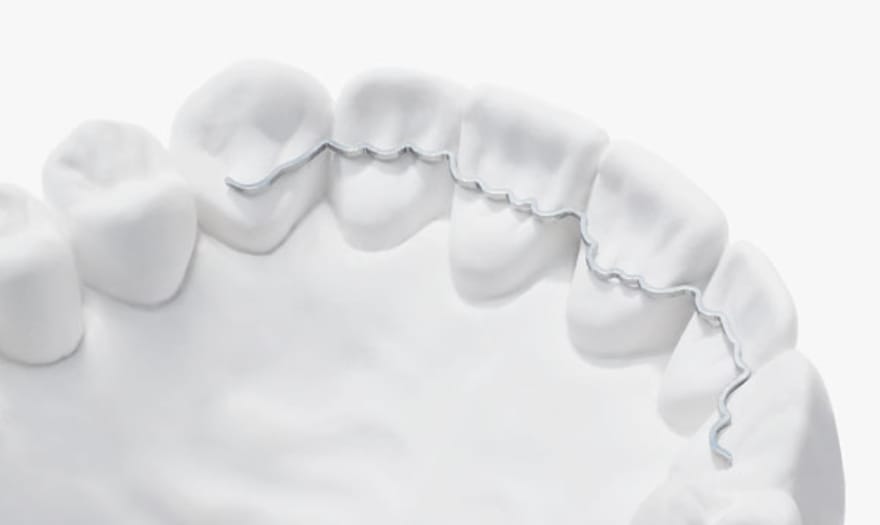
A periodontal splint joins several teeth with a fine wire bonded to their inner surface. Loose teeth lean on their more stable neighbours; chewing forces are shared across the group instead of concentrating on the weakest tooth, and chewing becomes more comfortable. The wire cannot be seen from the front.
A periodontal splint should be distinguished from the retainer fitted at the end of orthodontic treatment, which stops moved teeth returning to their original position. The principle is the same, but the aim differs: here, the point is to restore stability to teeth whose support is reduced.
The animation, step by step
The animation shows three moments. First, a digital impression of the teeth, taken with a camera, used to design a wire that fits their shape exactly. Next, the wire bonded on the tongue side, following the outline of each tooth. Finally, a conventional twisted wire held by composite pads, showing where plaque builds up around the pads and along the wire.
This last shot explains why caring for a splint matters as much as placing it: plaque trapped around the wire keeps the gums inflamed if it is not removed.
When is a splint useful?
A splint does not treat periodontitis. It is placed once inflammation is controlled by periodontal treatment, or temporarily during it if a tooth is too loose to clean or to chew comfortably.
The European guideline on the most advanced periodontitis (stage IV) states that temporary splinting of very loose teeth may be considered at every step of treatment, and that long-term splinting may be considered when mobility persists or increases, for patient comfort [1]. This is an open recommendation: studies are few [2]. The decision is therefore made case by case.
In practice, a splint is discussed when:
- residual mobility, after re-evaluation, interferes with chewing or brushing;
- mobility increases from one visit to the next even though the gums are healthy;
- a very loose tooth needs protecting during regenerative surgery on it or on a neighbour;
- teeth have drifted and orthodontic treatment has just moved them back into place.
When teeth have drifted, orthodontic treatment can be discussed once the disease is stable; a splint often completes it. Conversely, a tooth whose support is almost entirely lost, fractured or repeatedly infected is not saved by a splint: joining it to its neighbours risks dragging them down. Replacing it is then discussed on the Implants page.
The practical arrangements, the course of treatment and aftercare instructions are explained at the practice, according to your situation.
Living with a splint: hygiene and follow-up
A splint makes cleaning more demanding: the wire closes the gap between the teeth on the tongue side, and plaque builds up around the pads. On teeth whose support is already reduced, this plaque is the main danger. Daily care is therefore part of the treatment.
Cleaning between the teeth and under the wire is done every day with suitable interdental brushes, where ordinary floss no longer passes. The splint is checked at every maintenance visit, at a frequency that depends on your risk: the mobility of the joined teeth is reassessed there, and the bonding checked and repaired if needed.
What a splint does not do
A splint does not treat the disease: if inflammation returns, bone keeps being lost under a wire that hides the mobility. It does not rebuild lost support; a joined tooth is still a tooth with reduced support, whose prognosis depends on the stability of the gums. Nor does it replace correcting an overload: if a tooth receives excessive forces, adjusting how the teeth meet, or a night guard in case of clenching, is discussed alongside.
Its drawbacks are known: more demanding hygiene, debonding that needs repair, and the risk, if a tooth with too little support is included, of putting more strain on its neighbours. That is why the decision is made after re-evaluation, tooth by tooth, and why a tooth that cannot be kept is dealt with differently.
Frequently asked questions
Is the splint permanent?
It can be temporary, during treatment, or stay in place for several years if mobility persists. It is checked and repaired when needed.
Can it be seen?
Not from the front: the wire is bonded to the inner surface of the teeth.
Does it stop me losing the tooth?
It makes the tooth more comfortable, but controlling inflammation and maintenance are what protect its support.
What if the wire comes loose?
Contact the practice, without waiting for the next maintenance visit.
Does the splint damage the teeth?
It is bonded to the enamel without cutting it, and can be removed without damage. The risk comes not from the wire but from the plaque it holds if daily cleaning is not adapted.
References
- Herrera D, Sanz M, Kebschull M, Jepsen S, Sculean A, Berglundh T, Papapanou PN, Chapple I, Tonetti MS. Treatment of stage IV periodontitis: The EFP S3 level clinical practice guideline. J Clin Periodontol. 2022;49 Suppl 24:4-71. DOI
- Dommisch H, et al. Efficacy of tooth splinting and occlusal adjustment in patients with periodontitis exhibiting masticatory dysfunction: A systematic review. J Clin Periodontol. 2022. DOI
Patient pathway