Gum aesthetics: the gum frames the smile
A balanced smile does not depend only on the shape and colour of the teeth. The gum draws their outline: its height, how even it is from tooth to tooth and the papillae between the teeth. When this frame is out of balance, correcting the gum may be enough, or may prepare work on the teeth. This page explains what gum aesthetics can correct, in what order, and what it cannot promise.
What are we talking about?
Gum aesthetics covers the procedures that correct the shape, height or thickness of the gum to improve the appearance of the smile. The medical term is periodontal plastic surgery: minor surgical procedures, carried out under local anaesthetic, that move, remove or add gum tissue. They belong to the periodontist because they involve the tissues that support the tooth, and because their success depends first on the health of those tissues.
The most frequent requests fall into five groups: too much gum showing when smiling (gummy smile), an uneven or asymmetrical gum line from one tooth to the next, teeth that look short, dark spaces between the teeth after periodontitis ("black triangles"), and gum that has receded over a root. Each situation has its cause and its answer; some can be corrected well, others partially, and a few are not a matter of gum at all.
Health first: what gum aesthetics must not do
No aesthetic correction is done on inflamed gums. Gingivitis or periodontitis is treated and stabilised first; the gum line often changes after this treatment, because the gum loses its swelling and shrinks back where bone has been lost. Correcting the gum before that stage means working on an outline that is going to move, and hiding a disease that keeps progressing under a reshaped surface.
So it is on healthy gum, once periodontitis treatment is complete and the gum has stabilised, that what remains to be harmonised is judged. The same rule applies before veneers or crowns: the edge of a restoration placed on inflamed gum keeps the inflammation going and eventually becomes exposed.
The gummy smile: when too much gum shows
A gummy smile shows a large height of gum when smiling. It has several causes: teeth that look short because the gum did not recede normally after eruption (known as altered passive eruption), a very mobile or short upper lip, vertical growth of the upper jaw, sometimes gum thickened by inflammation or certain medicines. Treatment depends on the cause, hence the need for a precise examination and X-rays [1].
The examination measures the height of gum showing when you smile, the length of the visible crowns compared with their real length, the position of the junction between enamel and root under the gum, and the distance between that junction and the bone. This last measurement decides the procedure: if the bone is at the right distance, removing the excess gum is enough; if it is too close, the bone must also be reshaped, otherwise the gum returns to its former position [1].
When the gum covers part of the tooth, a gingivectomy reshapes its outline: the future gum line is traced, then the excess tissue is removed. At the practice this reshaping is done with a laser, which cuts the gum precisely and limits bleeding.
If the underlying bone is too close to the gum margin, it must also be reshaped: this is crown lengthening, which exposes more of the tooth and restores the normal distance between the bone and the gum margin. Other causes of a gummy smile call for other approaches, sometimes orthodontic or surgical; a very mobile lip, for instance, is not corrected by removing gum.
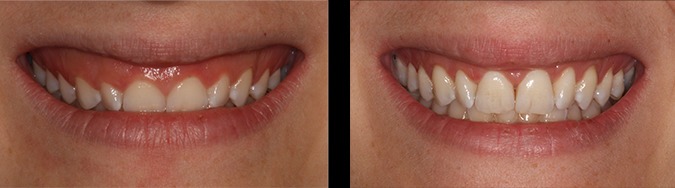
Uneven gum line, short teeth: harmony before veneers or crowns
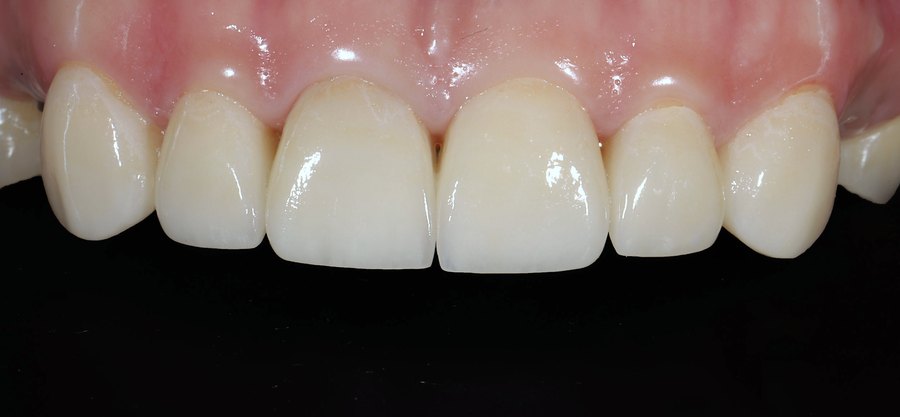
A gum line that is not level from one tooth to the next, or a single tooth that looks shorter than its neighbour, stands out all the more when the teeth themselves are regular. Reshaping tooth by tooth, by gingivectomy or crown lengthening, aligns the gum margins. It is planned according to the smile line, the lip line and the desired length of the teeth.
Before veneers or crowns on the front teeth, this step is often decisive: the dentist making the restorations needs a stable, symmetrical gum line to design teeth of equal length. Crown lengthening is also used when a tooth is too short to retain a crown. Gum correction comes before the restoration, to allow the new outline to settle; Dr Hazout coordinates these steps with the restorative dentist.
After periodontitis: black triangles and an uneven gum line
Treated periodontitis often leaves visible traces: the papillae between the teeth have shrunk, dark spaces appear (black triangles) and the gum line is no longer even. Whether a papilla is present depends largely on the distance between the contact point of the teeth and the bone: the greater the distance, the more likely the space stays open [2].
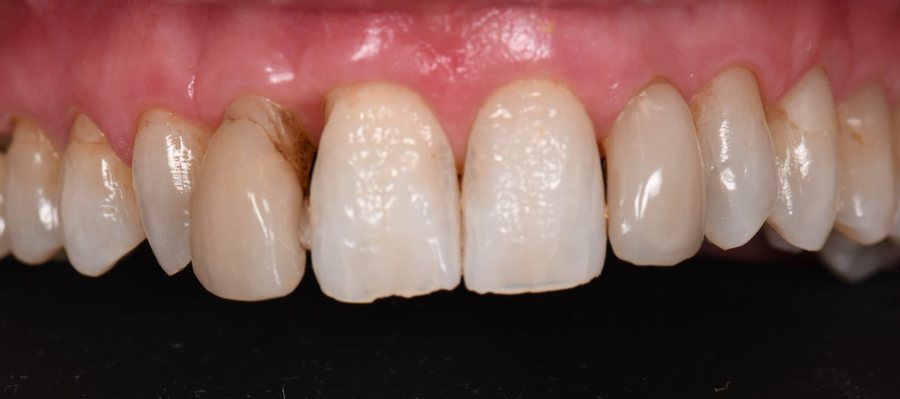
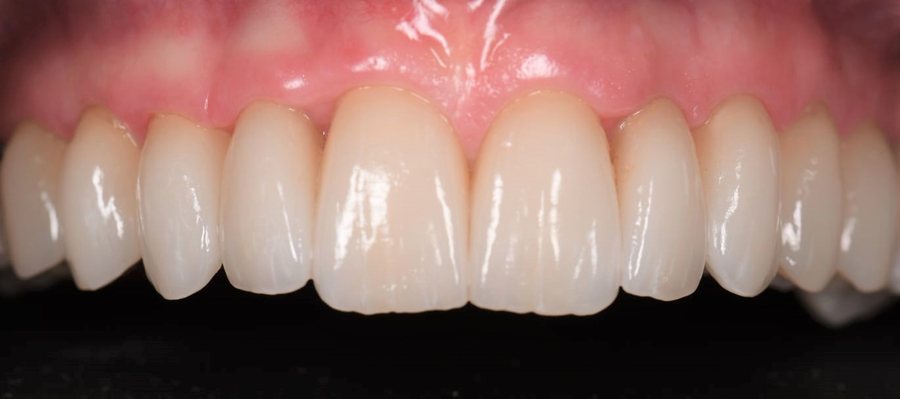
It is important to be clear about what is possible. Gum lost between the teeth does not grow back predictably: no graft recreates a papilla where the bone that supported it has gone. Balance is therefore restored by other levers: healthy, stable gums, gum corrections if needed, then changing the shape of the teeth (veneers, restorations, sometimes orthodontic closure) to close the spaces by moving the contact point towards the gum. The work is coordinated between the periodontist and the dentist who carries out the restorations.
Restorations that respect the gum
The edge of a crown or veneer sits against the gum. If it fits poorly or is stained, it traps plaque, keeps the gum inflamed and leaves a dark line in the smile. Before front-tooth restorations are redone, the gum is treated; the new edge is then placed and polished so that the gum stays healthy around it.
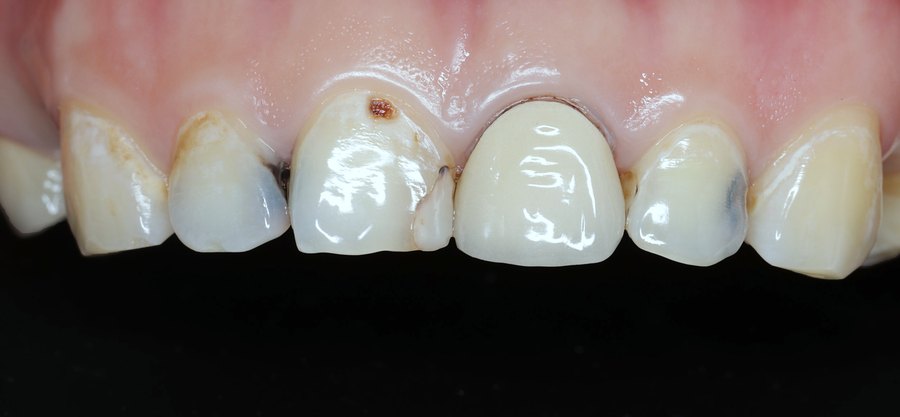
Gum recession
A receding gum makes the tooth look longer and the outline uneven. When the recession is suitable, a gum graft covers the root and thickens the gum. The signs, the criteria for deciding, the techniques and a before/after case are on the Gum recession and grafts page.
Who it is for, and when to hold back
These procedures are for patients whose gums are healthy or stabilised, who clean their teeth well and whose request matches what the gum can deliver. Several situations lead to postponing or deciding against treatment:
- active or unreassessed periodontitis: correction waits for stabilisation;
- smoking, which slows healing and compromises the result; stopping is discussed;
- insufficient plaque control: a new gum line only stays sharp if it is maintained;
- very thin gum or insufficient bone, which limit what can be removed or reshaped without creating a recession;
- an expectation that does not depend on the gum: a short lip, teeth whose shape or colour is the issue, black triangles due to major bone loss;
- certain medicines (anticoagulants, drugs acting on bone) or general conditions that call for coordination with the treating physician.
The analysis before any correction
The first step is an analysis visit at the Levallois-Perret practice: photographs of the smile, examination of the gum, pocket depth measurements and X-rays to locate the bone. Dr Hazout shows you what he proposes to correct, and what he does not. When restorations are planned, the plan is drawn up with the dentist who will make them, so that the gum is corrected to suit the teeth to come.
The practical arrangements, the course of treatment and aftercare instructions are explained at the practice, according to your situation.
Results, limits and follow-up
When the indication is right and the bone has been taken into account, the new outline of a gummy smile or an uneven gum margin is stable over time. On the other hand, gum aesthetics does not recreate a lost papilla, does not lengthen a short lip and does not replace orthodontic treatment when it is the teeth that are out of place. The photographs on this page are individual cases; they do not predict another patient's result.
Follow-up is that of any gum: regular visits, included in periodontal maintenance for patients treated for periodontitis. The aesthetic result then depends as much on daily care as on the initial procedure. The practice's fee ranges are given on the Fees page; a written estimate is provided after the analysis.
Frequently asked questions
Is a gingivectomy permanent?
Yes, when the indication is right: if the bone is at the right distance from the new gum margin, the outline stays stable. If the bone is too close, the gum tends to return; that is why it is checked before the procedure.
Why a laser?
It allows a precise outline of the new gum line and coagulates as it cuts, which limits bleeding. It does not replace checking the bone level before the procedure.
Can black triangles disappear?
Rarely through the gum alone. When the papilla has gone with the bone that supported it, it does not grow back predictably. The spaces are closed mainly by changing the shape or position of the teeth, once the gum is stable.
Can the gum be corrected after periodontitis?
Yes, once the disease is stabilised and the gum is healthy again. The examination then defines what can be harmonised and what is better addressed by changing the teeth.
References
- Mele M, Felice P, Sharma P, Mazzotti C, Bellone P, Zucchelli G. Esthetic treatment of altered passive eruption. Periodontol 2000. 2018;77(1):65-83. DOI
- Tarnow DP, Magner AW, Fletcher P. The effect of the distance from the contact point to the crest of bone on the presence or absence of the interproximal dental papilla. J Periodontol. 1992;63(12):995-996. PubMed
Patient pathway