Periodontitis and diseases of the heart and blood vessels: where does the evidence stand?
People with periodontitis more often have cardiovascular disease. Cardiology and periodontology societies acknowledge this. But they also stress that no trial has yet shown that treating the gums reduces heart attacks or strokes. This article explains what the studies allow us to say, what they do not, and what this means for a patient with heart disease.
Key points
- Independent association between severe periodontitis and cardiovascular disease: EFP–World Heart Federation consensus (2020) [1] and American Heart Association statement (2025) [2].
- Mechanisms studied: bacteraemia, low-grade inflammation, endothelial dysfunction [3].
- Causation not established according to the AHA [2].
- Treatment improves markers (CRP, endothelial function in one trial) [4] [5], but its effect on cardiovascular events has not been demonstrated [6].
- If you take an anticoagulant or an antiplatelet drug, never stop it without medical advice.
An association recognised by cardiologists
Atherosclerosis is the thickening of artery walls by plaques made of fats and inflammatory cells. It causes most heart attacks and ischaemic strokes. In 2020, a joint workshop of the European Federation of Periodontology and the World Heart Federation concluded that a substantial body of evidence supports independent associations between severe periodontitis and cardiovascular disease [1]. 'Independent' means that the association persists after taking into account shared factors such as smoking, age or diabetes, as far as studies were able to measure them.
In December 2025, the American Heart Association (AHA) published a new scientific statement updating its 2012 statement. It confirms the association with heart attack, stroke, atrial fibrillation and heart failure, and highlights the role of shared risk factors [2]. The word used is 'association': cardiologists do not write that periodontitis causes these diseases.
The mechanisms studied
- Direct pathway: bacteria from the pockets, including Porphyromonas gingivalis, enter the bloodstream; they have been found in atheromatous plaques and can invade cells of the vessel wall [3] [2].
- Indirect pathway: periodontitis sustains chronic low-grade inflammation, with raised CRP, IL-6 and TNF-α [2].
- Endothelial dysfunction: the endothelium, the layer of cells lining the inside of blood vessels, controls their dilation; its impairment is an early stage of atherosclerosis [3].
- Cross-reactive immune responses: antibodies against periodontal bacteria might also recognise structures in the vessel wall (molecular mimicry) [2].
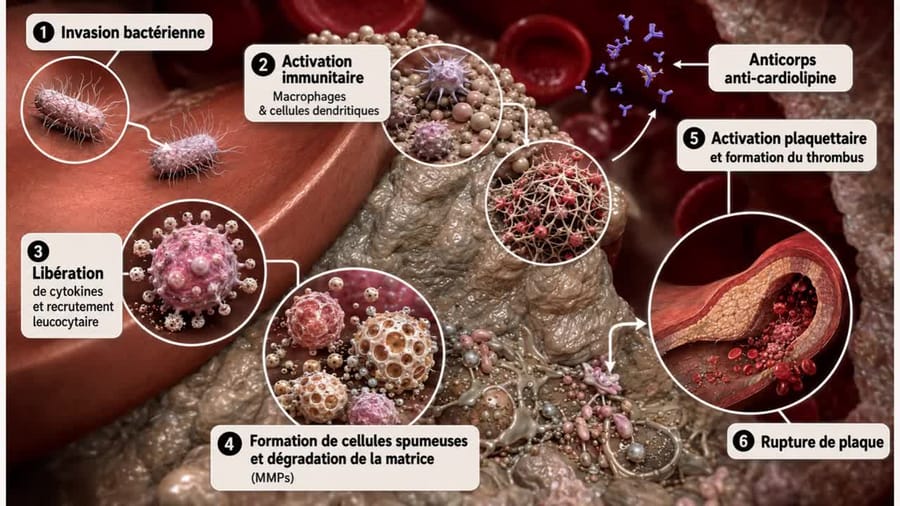
These mechanisms are plausible and documented in the laboratory or in animals. In humans, they explain why the association is taken seriously; they are not enough to show that it is causal.
Why causation has not been established
Smokers and people with diabetes or excess weight have both more periodontitis and more cardiovascular disease. Even with statistical adjustment, part of the association may come from these shared factors. Genetic studies known as Mendelian randomisation show no causal link with coronary atherosclerosis, but a signal for some strokes of cardiac origin; their genetic tools remain weak, however [7]. The AHA concludes that well-designed longitudinal studies and randomised trials are needed [2].
Why are such trials lacking? To show that a treatment reduces the number of heart attacks, several thousand people must be followed for years, with one group left without full periodontal treatment, which raises an ethical problem since periodontitis needs treating in its own right. Researchers therefore rely on intermediate markers that are easier to measure: blood-vessel function, CRP, blood pressure. An improvement in these markers is encouraging, but it is not enough to establish a fall in cardiovascular events.
Reverse effects must also be considered: some general diseases, or their treatments, may favour periodontitis. Only trials can disentangle these effects.
What periodontal treatment actually changes
On markers, the results are broadly favourable, with some nuances:
- In 2007, a randomised trial published in the New England Journal of Medicine (120 patients with severe periodontitis) showed that intensive treatment temporarily worsens endothelial function the next day, then clearly improves it at 60 and 180 days compared with usual care [5]. A more recent meta-analysis, however, finds no statistically significant improvement in endothelial function [8].
- A meta-analysis of 26 randomised trials shows an average fall in CRP of 0.69 mg/L six months after treatment [4].
- Another meta-analysis finds a fall in IL-6 and systolic blood pressure (moderate certainty), but no improvement in blood lipids [8].
On cardiovascular events (heart attack, stroke, death), the 2022 Cochrane review found only two trials, with very low-certainty evidence: it is not possible to say whether periodontal treatment prevents a first cardiovascular disease, and there is no reliable evidence on preventing recurrence [6]. Further trials are considered necessary by both Cochrane and the AHA [6] [2].
In practice, if you have cardiovascular disease
- Antithrombotic medicines (anticoagulants, antiplatelet drugs): they must not be stopped without the advice of the prescribing doctor. The EFP–WHF consensus devotes part of its recommendations to periodontal treatment in these patients [1].
- Prevention of endocarditis: if you have an artificial heart valve or a history of endocarditis, say so; antibiotic prophylaxis may be required according to cardiology guidelines.
- Coordination: the EFP–WONCA consensus encourages dentists to identify cardiovascular risk factors and refer to the GP [9]. With your consent, a periodontal report is sent to your GP or cardiologist.
- Lifestyle: stopping smoking is recommended from the first step of periodontal treatment [10]; it benefits the heart as well as the gums. Diet and weight also matter for both (see nutrition and inflammation).
Treatment is described on the periodontitis treatment page; at the practice in Levallois-Perret, it is offered because it treats the mouth, not as a heart treatment. Your cardiology follow-up, your medicines and control of blood pressure, cholesterol and smoking remain the measures with proven benefit for the heart. Once periodontitis is stabilised, periodontal maintenance keeps gum inflammation under control, which is the reasonable goal to keep in mind.
Should you worry about your heart if you have periodontitis?
The honest answer comes in two parts. No, periodontitis is not a proven cardiovascular risk factor in the same way as smoking, high blood pressure or cholesterol: cardiologists speak of an associated factor [2]. Yes, finding periodontitis is a good opportunity to review these established risk factors with your GP, especially as smokers and people with diabetes are over-represented among periodontal patients [9].
There is therefore no reason to request a cardiac work-up because you have periodontitis. There is every reason, however, to treat it for the sake of your teeth and not to neglect a blood pressure or blood sugar that has never been measured. The overview of the links between periodontitis and general health places this link among the others, with the same standard of evidence.
Frequently asked questions
Is periodontitis a cardiovascular risk factor like smoking?
It is independently associated with cardiovascular disease but, unlike smoking, its causal role has not been demonstrated. It is therefore better described as an associated factor.
Will having my gums treated reduce my risk of a heart attack?
This is not known. Treatment lowers CRP and improved blood-vessel function in one trial, but no trial has shown fewer heart attacks or strokes.
I take an anticoagulant: can I be treated?
Yes, in the vast majority of cases, without stopping the medicine. Arrangements are adapted with your doctor if needed.
Does periodontal treatment lower cholesterol?
Recent meta-analyses show no clear improvement in blood lipids after periodontal treatment.
Is treatment risky for the heart?
Intensive treatment causes a temporary inflammatory reaction the next day; in the trial that measured it, blood-vessel function then improved compared with usual care.
Should I have a cardiac work-up because I have periodontitis?
Not for that reason alone. However, if you smoke, are overweight, or have never had your blood pressure and blood sugar measured, it is a good time to discuss this with your GP.
References
- Sanz M, Marco del Castillo A, Jepsen S, Gonzalez-Juanatey JR, D'Aiuto F, Bouchard P, et al. Periodontitis and cardiovascular diseases: Consensus report. J Clin Periodontol. 2020;47(3):268-288. DOI
- Tran AH, Zaidi AH, Bolger AF, Del Brutto OH, Hegde R, Patton LL, Rausch J, Zachariah JP ; au nom des comités de l’American Heart Association. Periodontal disease and atherosclerotic cardiovascular disease: a scientific statement from the American Heart Association. Circulation. 2026;153:e73-e88 (publié en ligne le 16 décembre 2025). DOI
- Hajishengallis G, Chavakis T. Local and systemic mechanisms linking periodontal disease and inflammatory comorbidities. Nat Rev Immunol. 2021;21:426-440. DOI
- Luthra S, et al. Treatment of periodontitis and C-reactive protein: A systematic review and meta-analysis of randomized clinical trials. J Clin Periodontol. 2023;50(1):45-60. DOI
- Tonetti MS, D'Aiuto F, Nibali L, Donald A, Storry C, Parkar M, et al. Treatment of periodontitis and endothelial function. N Engl J Med. 2007;356(9):911-920. DOI
- Ye Z, Cao Y, Miao C, Liu W, Dong L, Lv Z, Iheozor-Ejiofor Z, Li C. Periodontal therapy for primary or secondary prevention of cardiovascular disease in people with periodontitis. Cochrane Database Syst Rev. 2022;10(10):CD009197. doi:10.1002/14651858.CD009197.pub5. DOI
- Zhao Y, Zhang C, Chang X, Zhang J, Shu C, Lin C, Hou J. Causal association between periodontitis and systemic diseases: a systematic review and meta-analysis of mendelian randomization studies. BMC Oral Health. 2026;26:383. DOI
- Meng R, Xu J, Fan C, Liao H, Wu Z, Zeng Q. Effect of non-surgical periodontal therapy on risk markers of cardiovascular disease: a systematic review and meta-analysis. BMC Oral Health. 2024;24:692. DOI
- Herrera D, Sanz M, Shapira L, Brotons C, Chapple I, Frese T, et al. Association between periodontal diseases and cardiovascular diseases, diabetes and respiratory diseases: Consensus report of the Joint Workshop by the European Federation of Periodontology (EFP) and the European arm of the World Organization of Family Doctors (WONCA Europe). J Clin Periodontol. 2023;50(6):819-841. DOI
- Sanz M, Herrera D, Kebschull M, Chapple I, Jepsen S, Berglundh T, et al. Treatment of stage I–III periodontitis—The EFP S3 level clinical practice guideline. J Clin Periodontol. 2020;47(Suppl 22):4-60. DOI
Related treatments

How periodontitis is treated: from assessment to stability
Treating periodontitis is more than a “deep clean”. It starts with a precise assessment, follows the steps defined by the 2020 European guideline and is judged on…

Periodontitis and general health: what the studies actually show
Periodontitis is a chronic inflammation of the tissues that support the teeth. Many studies associate it with general diseases: diabetes, heart and blood-vessel disease,…
Read next
Periodontitis and Alzheimer's disease: a real association, unproven causation
Several large studies, including two cohorts published in 2026, associate periodontitis with a higher risk of dementia and Alzheimer's disease. Other cohorts do not find…

Nutrition, micronutrition and periodontal inflammation: what the evidence shows
Diet influences gum inflammation: a few randomised trials show this, over short periods and with modest effects. The idea that periodontitis contributes to the chronic…
Understanding periodontitis: recognising the signs and how it is diagnosed
Periodontitis is one of the most common chronic diseases, and one of the least noticed. It often progresses without pain, and its first signs look like merely irritated…
Patient pathway